
Is AI Destroying the Planet – Or About to Save It?
I recently received this message from a reader, and I thought it deserved a full post rather than just a quick reply.
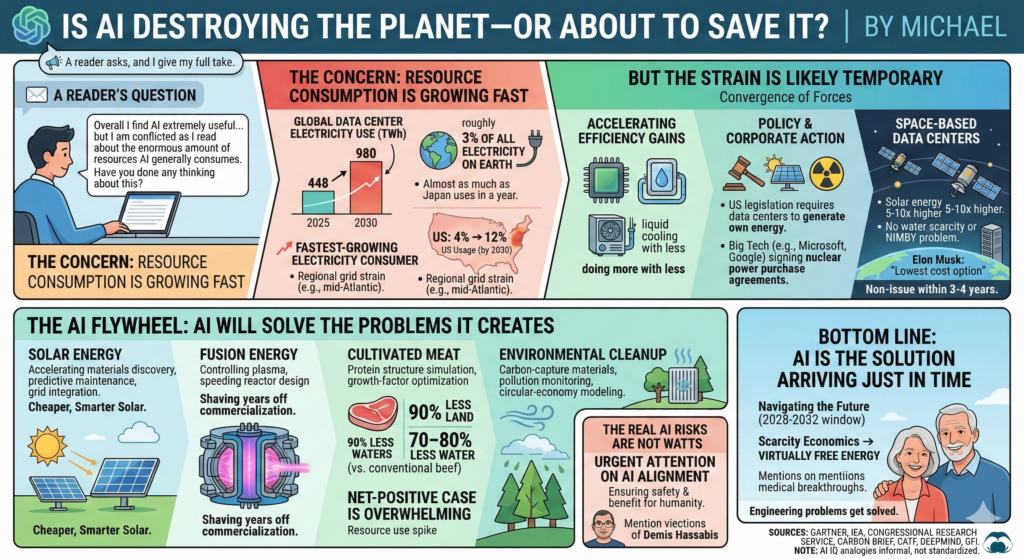
A reader asks the question I’ve been thinking about reply:
“Overall I find AI extremely useful and it’s helped me get past plateaus and blockages in many areas of interest to me. I am, however, conflicted as I read about the enormous amount of resources AI generally consumes to operate. Have you done any thinking about this? And if so, have you reached any conclusions about it?”
Great question—and honestly, a completely fair one to be conflicted about. Let me give you my full take.
Yes, the Numbers Are Real—and Growing Fast
The concern is legitimate. Data centers are the fastest-growing electricity consumer on the planet right now, and AI is the main reason why.
According to Gartner, global data center electricity use hit 448 TWh in 2025 and is on track to nearly double to 980 TWh by 2030. The IEA’s 2025 Energy and AI report lands in a similar place, projecting consumption reaches around 945 TWh by 2030—roughly 3% of all electricity on Earth. To put that in plain terms: the world is about to spend almost as much electricity running AI infrastructure as the entire nation of Japan uses in a year.
In the US, it’s already about 4% of our national electricity use, and some projections have that hitting 12% by 2030 in high-growth scenarios. Parts of the country—especially the mid-Atlantic grid—saw electricity rates jump up to 20% in summer 2025, partly as a result.
So yes—this is real, it’s happening now, and it’s worth taking seriously. But here’s why I don’t think it’s the story people assume it is.
This Strain Is Likely Temporary
Several forces are converging to make this a transitional problem rather than a permanent one:
- Efficiency gains are accelerating. New chip architectures and liquid cooling systems are dramatically cutting the energy required per unit of computation. The history of computing is a history of doing more with less.
- Policy is catching up. US legislation is moving toward requiring data centers to generate their own energy. Microsoft and Google are already signing nuclear power purchase agreements. Big Tech is being pushed to internalize these costs rather than externalizing them onto the grid.
- Data centers are heading to space. This one sounds like science fiction, but it’s not. Several large companies are now working on space-based data center infrastructure, where solar energy availability is 5–10x higher than on Earth, there’s no water scarcity, and the NIMBY problem disappears entirely. Elon Musk has said “space-based AI is obviously the only way to scale” and projected it could be the lowest-cost option within a few years. I think this becomes a non-issue within 3–4 years.
The AI Flywheel: It Will Solve the Problems It Creates
Here’s where I land on this: the net-positive case is overwhelming, and it gets stronger the further out you look.
AI models are currently operating at roughly a 130 IQ equivalent. Within a year or two, credible projections put that north of 200. That level of intelligence applied to our biggest problems is not incremental – it’s transformational. And some of those problems are the very environmental concerns people are worried about today:
- Solar energy: AI is already accelerating materials discovery, predictive maintenance, and grid integration for solar. Cheaper, smarter solar is coming faster because of AI.
- Fusion energy: Regarded as the ultimate future of clean energy. AI is now being used to control the superheated plasma inside fusion reactors (a problem that stumped engineers for decades) and to dramatically speed up reactor design. According to CATF, AI combined with high-performance computing could shave years off commercialization timelines. Fusion has been “20 years away” for 60 years—AI may finally close that gap.
- Cultivated meat: AI is enabling protein structure simulation and growth-factor optimization for lab-grown meat. New processes are cutting land use by 90% and water use by 70–80% compared to conventional beef. This is a massive environmental multiplier hiding in plain sight.
- Environmental cleanup: AI is being applied to carbon-capture materials, pollution monitoring, and circular-economy modeling. The intelligence to find solutions that humans have missed for decades is being brought to bear.
The resource use spike happening right now is funding the abundance that’s coming. Be the way, this is the pattern of every major technology transition in history.
The Real AI Risks Go Beyond Resource Use
To be clear there are serious AI risks that deserve urgent attention. But resource consumption isn’t at the top of that list. The risks I’m watching are alignment – making sure increasingly powerful AI systems remain safe and beneficial to humanity. Demis Hassabis (of Google’s DeepMind) and others at the frontier of this technology have spoken about this at length.
It would be nice if the AI companies would slow down to give humanity more time to adjust. But given the stakes – economically and geopolitically – that’s highly unlikely. It’s coming one way or another. The better question is how we navigate it well. (what this blog is about!)
The Retirement Singularity Angle: This Is the Last Resource Bottleneck
If you’re reading this blog, you’re thinking about what the next 20–30 years look like—for your health, your finances, your quality of life, and the world your kids and grandkids inherit.
Here’s my take: the AI-driven resource strain we’re seeing right now is the last gasp of “scarcity” economics. Once fusion and orbital solar and AI-enabled cleanup reach scale- realistically the 2028–2032 window – energy transitions toward being virtually free. Combine that with the medical breakthroughs that AI is accelerating, and the retirement you’re planning for looks dramatically different than anything prior generations could have imagined.
Short-term resource pain. Exponential long-term gain. The trade is a good one.
Bottom Line
AI isn’t the problem. It’s the solution arriving just in time – but not quite fast enough for the worriers, and not quite slow enough for the cautious. The environmental concerns are legitimate and worth tracking. But they’re engineering problems, and engineering problems get solved. Especially when you have exponentially smarter engineers working on them!
Thanks for the great question. Keep them coming.
Live long, live well & prosper!
Michael
Sources: Gartner Forecast Analysis: Data Center Power Consumption (Nov. 2025); IEA Energy and AI special report (2025); Congressional Research Service R48646 (2025); Carbon Brief AI data center analysis (Sept. 2025); CATF AI + Fusion report; DeepMind plasma control research (Nature, 2022); Cultivated meat lifecycle analysis (Good Food Institute). Note: AI IQ comparisons are informal analogies used by AI researchers and commentators.
Related Posts
 Apple TV’s Pluribus, Hive Minds, and the Stories We Tell Ourselves About AI
 Using Meditation to Cope with AI’s Mind Games
 Singularity University’s Salim Ismail on the Age of Technological Disruption
 Radical Life Extension, Global Economics and Your Retirement
 Fireside Chat with Zoltan Istvan – Author of “The Transhumanist Wager”