Aging Research Advancing at Hyper-Speed with AI’s Help

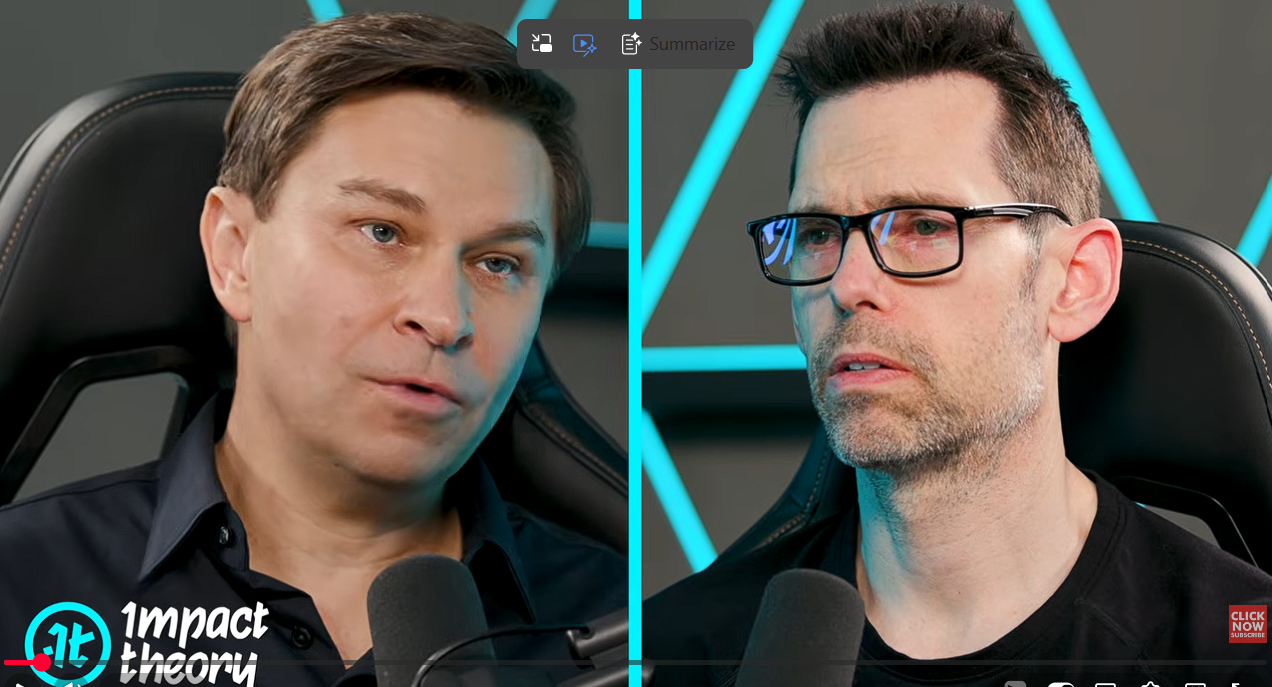
David Sinclair Tom Bilyeu
AI Just Compressed 160 Years of Aging Research – Here’s What They Found
I want to tell you about something that is happening in a Harvard lab that quietly changes the assumptions we have about getting older.
Harvard geneticist David Sinclair was recently on Tom Bilyeu’s Impact Theory, and he said something that had me pause the replay. His lab has been using AI to screen molecules – billions of them – looking for compounds that might reverse aging at the cellular level. Work that would have taken, by his estimate, about 160 years using traditional methods? It’s now happening in months.
That’s not a typo. One hundred and sixty years. That’s the power of AI applied to medical research!
Here is what’s actually being claimed here, and why it’s worth paying attention even if you’re appropriately skeptical.
The idea isn’t as strange as it sounds
Sinclair’s framework is called the Information Theory of Aging. The basic argument: aging isn’t really about wear and tear. It’s more like a scratched CD. The data is still there – your cells still hold the original instructions for functioning like a younger version of themselves, but something has interfered with the playback.
That “something” is a gradual loss of what biologists call epigenetic information. The signals that tell your cells which genes to activate, and which to leave alone, get noisier over time. Degradation over time can make one type of cell think it is another type of cell – causing problems.
The interesting part? His team believes those original instructions can be restored.
What they’ve actually done so far
Using a specific combination of genes – abbreviated as OSK – Sinclair’s lab has reversed signs of aging in mice. Eyes. Brains. Muscle. Skin. In one well-documented experiment, they restored vision in mice with damaged optic nerves. They’ve since replicated similar results in monkeys.
They’ve also de-aged miniature human brain tissue in the lab, restoring firing patterns associated with learning and memory.
“We grow miniature brains. We give them Alzheimer’s. We make them old. And then we de-age those with our chemicals and our genes.”
This doesn’t prove it will work in humans. It’s early. But the direction is clear.
What AI has done is make the search for how to do this chemically – without gene therapy, without the complexity of viral delivery – move dramatically faster. They’re now identifying single molecules that may do what the gene combinations do. Eventually, if this works, we may be talking about a pill or even a topical cream.
Sinclair is hoping to have a simpler pill form of the gene therapy that will have much of the power, and this might be soon! We will know within a year.
Why this might actually matter to you
If you’re between 55 and 80, you’re probably not sitting around waiting for immortality. You just want more good years. More cognitive sharpness. Less of the slow decline that seems to arrive whether you invite it or not.
Here’s the honest version of what Sinclair is suggesting: if even some of this holds up in human trials – which are now starting – the people most likely to benefit first are the ones alive today. That means this isn’t just a story about future generations. It might be a story about your generation.
No one can tell you when, or guarantee it works. Anyone who claims otherwise is overselling. But the trajectory is no longer theoretical.
What you can do right now
Sinclair is also consistent about something else: the lifestyle choices you’re making today are already working on the same biological pathways. Intermittent fasting. High-intensity exercise – even brief bursts, even once or twice a week. Quality sleep. These aren’t just good habits. They may be actively preserving the very cellular information that future therapies will attempt to restore.
You don’t need to overhaul your life. You just need to stay in the game.
A different way to think about the years ahead
Most retirement planning is built around a quiet assumption: that your 70s will be harder than your 60s, your 80s harder still if you make it. That’s been true historically. It may not be the only possibility anymore.
I’m not telling you to stop planning for difficulty. I’m suggesting you leave a little room in that plan for something else – for the possibility that the researchers working on this are further along than most of us realize, and that the window isn’t as far away as it once seemed.
You don’t need to master the science. You just need to stay curious.
Live long, live well & prosper!
Michael
We’re tracking these developments at RetirementSingularity.com — translating what’s happening in the labs into what it might mean for how you actually live. What questions does this raise for you? Drop them in the comments.