
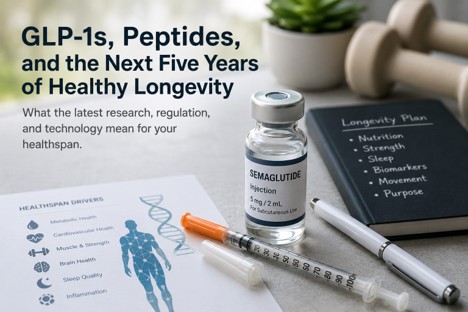
GLP-1s – Peptides and the Next Five Years of Healthy Longevity
 GLP-1 drugs are changing the way people think about weight, metabolism, and long-term health. Originally developed for diabetes, drugs like semaglutide and tirzepatide are now being discussed in a much bigger context: could they help people live healthier for longer?
The answer is promising, but it needs to be framed carefully. GLP-1s are not proven “anti-aging drugs.” At least not yet. But they may help reduce some of the biggest drivers of unhealthy aging, including obesity, insulin resistance, cardiovascular disease, fatty liver disease, sleep apnea, and kidney disease. In other words, their real longevity value may come from helping people avoid or delay the chronic diseases that shorten healthspan.
Healthspan means the number of years you live in good health, with energy, mobility, independence, and lower disease burden. That is different from lifespan, which simply means how long you live. For many people interested in longevity, healthspan is the more practical initial goal.
The most exciting idea is that GLP-1s may help with what researchers sometimes call “disease compression.” This means pushing major illness later in life, so more years are spent feeling and functioning well. If a medication helps someone reduce excess visceral fat, improve blood sugar, lower cardiovascular risk, sleep better, and protect the liver or kidneys, it may meaningfully improve the quality of later life.
A recent study has made this conversation even more interesting. In 2026, researchers reported results from a randomized trial of semaglutide in adults with a HIV-associated condition involving abnormal fat accumulation and accelerated aging. Semaglutide appeared to reduce biological aging signals across several epigenetic clocks. One measure suggested about a 9% slower pace of aging compared with placebo.
That is a fascinating finding, but it is important not to overstate it. This does not mean semaglutide has been proven to extend human life by 9%. It was a biomarker finding, in a specific group of people, over a relatively short period of time. Still, it gives the longevity field a serious signal to watch. It suggests GLP-1s may affect more than weight alone.
That is why some longevity researchers are paying close attention. One leading researcher I follow, Alex Zhavoronkov, founder and CEO of Insilico Medicine, has said there are signs that GLP-1s could potentially become the first true longevity drug. The good way to frame this is: GLP-1s may be the first widely used drug class with credible evidence across both disease-risk reduction and biological-aging biomarkers. That does not make them a confirmed longevity therapy yet, but it does put them on the shortlist of drugs to watch closely.
Over the next five years, the biggest impact will likely come from better, more personalized metabolic medicine. GLP-1s and related drugs may become easier to take, easier to dose, and more targeted to individual needs. Oral GLP-1 options, lower-dose maintenance strategies, dual agonists, and triple agonists are all being developed or studied. These next-generation drugs may help patients and clinicians move beyond the simple goal of “maximum weight loss” toward a smarter goal: improving metabolic health while preserving strength, nutrition, and quality of life.
Something to consider; for longevity, weight loss is not automatically good. Losing fat can be extremely beneficial for the right person, but losing too much muscle can be harmful, especially as people age. A healthy longevity strategy should focus on body composition, strength, protein intake, resistance training, sleep, and healthy socialization, not just the number on the scale.
This is where AI could play a major role. Used well, AI could help clinicians, and us, personalize treatment. It could help answer questions like: Who is most likely to benefit from a GLP-1? Who is at higher risk for side effects? What dose is enough? Is the person losing fat while preserving muscle? Are lab markers improving? Are sleep, energy, and cardiovascular risk moving in the right direction?
AI could also help monitor real-world safety. GLP-1s can cause gastrointestinal symptoms. Some people may experience dehydration, gallbladder issues, appetite suppression that goes too far, or nutrition problems. The future of safe peptide-based longevity will depend on better tracking, better follow-up, and earlier detection of problems.
But there is another side to the story. AI could also make unsafe use easier to scale. Telehealth platforms, medspas, and direct-to-consumer programs may use automation to sell more products without enough medical oversight. This is especially concerning as interest grows in unapproved GLP-1s and other peptides. Further, some products may be unpure.
The same issue applies to other peptides popular in longevity and wellness circles. In July 2026, the FDA’s Pharmacy Compounding Advisory Committee reviewed several peptide-related substances. Peptides are often discussed for recovery, inflammation, sleep, cognition, mitochondrial health, and aging. Some may eventually prove useful, but many claims are still ahead of strong human evidence. We are still early in this exciting space – so buyer beware!
The most realistic five-year forecast re the evolution of peptides is a more personalized metabolic health toolkit. GLP-1s and related therapies may help the right people reduce chronic disease risk, improve function, and protect healthspan.
For people interested in healthy longevity, the takeaway is clear: GLP-1s are worth watching, and for some people they may be genuinely life-changing. But IMO they should be approached as serious medical tools, not casual wellness hacks. The future belongs to programs that combine medication, nutrition, strength training, lab monitoring, AI-assisted personalization, and responsible clinical oversight.
Live long, live well & prosper!
Michael
References
- Nature Communications. “Semaglutide reduces epigenetic aging in adults with HIV-associated lipohypertrophy.” 2026.
- Fortune. Coverage of Alex Zhavoronkov’s comments on GLP-1s as potential longevity drugs. 2025.
- ScienceDirect. 2026 modeling study estimating life-expectancy impact of semaglutide in a SELECT-like cardiovascular-risk population.
- Axios. “Unapproved obesity drug spawns a black market frenzy.” August 2026.
- U.S. Food and Drug Administration. “FDA’s concerns with unapproved GLP-1 drugs used for weight loss.”
- U.S. Food and Drug Administration. July 23–24, 2026 Pharmacy Compounding Advisory Committee meeting materials.
- Mintz. “FDA’s Advisory Committee Votes on Peptides: What It Does and Does Not Mean.” July 2026.
Stay informed with RS
Want more perspective on AI, healthy longevity and life after 60? Join me for the Retirement Singularity Weekly Briefing, plus email notifications of new blog posts.
Subscribe to the RS Weekly Briefing and blog updates. You can unsubscribe at any time.